
Refrigerator Repair: Why Your Ice Maker Stopped Working
Few refrigerator problems are as frustrating as reaching for a glass of ice on a hot day and discovering the ice bin is completely empty. Sometimes the ice maker slows down gradually. Other times, it stops producing ice overnight without any obvious warning.
Many homeowners immediately assume the ice maker itself has failed. In reality, an ice maker depends on several different systems working together, including the water supply, freezer temperature, sensors, motors, and electronic controls. If just one of these components stops working correctly, ice production can come to a halt.
The good news is that most ice maker problems can be diagnosed and repaired without replacing the entire refrigerator.
How Does a Refrigerator Ice Maker Work?
Although different brands use different designs, most automatic ice makers follow the same basic process.
The refrigerator:
- Maintains the freezer at the proper temperature.
- Fills the ice mold with water.
- Freezes the water into cubes.
- Releases the cubes into the storage bin.
- Refills the mold and repeats the cycle.
If any step in this process is interrupted, the refrigerator may stop making ice completely or produce much less ice than usual.
Check the Freezer Temperature First
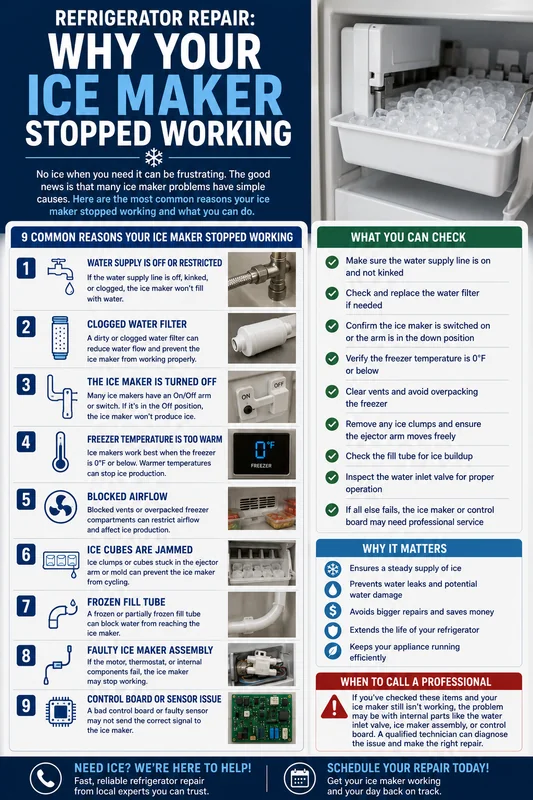
One of the simplest causes of poor ice production is a freezer that’s slightly too warm.
Most ice makers require freezer temperatures of approximately 0°F to operate correctly.
If the freezer temperature rises above this range, the ice maker may:
- Stop producing ice
- Produce smaller cubes
- Take much longer between cycles
- Create soft or partially frozen cubes
Even if food still appears frozen, the freezer may not be cold enough for consistent ice production.
A Clogged Water Filter Can Reduce Water Flow
Most refrigerators with built-in ice makers use replaceable water filters.
As the filter becomes clogged with sediment and minerals, water flow decreases.
Common symptoms include:
- Smaller ice cubes
- Slow ice production
- Hollow cubes
- No ice at all
- Reduced water dispenser pressure
Replacing the water filter according to the manufacturer’s schedule often restores normal performance.
The Water Inlet Valve May Be Failing
The water inlet valve controls the flow of water into the refrigerator.
Each time the ice maker requests water, the valve opens briefly to fill the ice mold.
If the valve begins to fail, you may notice:
- No water entering the ice maker
- Intermittent ice production
- Very small cubes
- Buzzing sounds during the fill cycle
Because the valve operates electrically, professional testing is usually required to confirm whether it’s functioning correctly.
A Frozen Fill Tube Can Block Water
The small tube that delivers water into the ice maker can occasionally freeze.
When this happens, water cannot reach the ice mold.
Possible causes include:
- Low freezer temperatures
- A leaking water valve
- Restricted airflow
- Ice buildup near the fill tube
This is a common issue in many refrigerator models and should be corrected before additional ice accumulates.
The Ice Maker Assembly May Be Worn Out
Like any mechanical device, an ice maker eventually reaches the end of its service life.
Over time, motors, gears, switches, and internal mechanisms wear out.
Signs of a failing ice maker include:
- Ice production stopping completely
- Grinding or clicking noises
- Cubes becoming stuck
- Harvest cycles failing
- Irregular ice production
Depending on the model, replacing the complete ice maker assembly is sometimes the most practical repair.
Temperature Sensors Can Affect Ice Production
Modern refrigerators rely on electronic sensors to monitor freezer conditions.
If a sensor sends inaccurate temperature information, the refrigerator may delay or cancel ice-making cycles.
Possible symptoms include:
- Random changes in ice production
- Error codes
- Inconsistent freezer temperatures
- Ice maker operating only occasionally
Proper electronic diagnostics help identify sensor-related problems quickly.
The Ice Bin May Be Preventing Production
Sometimes the problem is surprisingly simple.
If the ice bin isn’t installed correctly or the shutoff arm becomes stuck, the refrigerator may believe the bin is already full.
This causes the ice maker to stop producing additional ice.
Always check that:
- The bin is fully seated.
- The shutoff arm moves freely.
- No ice is jamming the mechanism.
These quick checks can sometimes solve the problem without requiring repairs.
Frost Buildup Can Affect the Ice Maker
Frost inside the freezer doesn’t just affect cooling.
It can also interfere with ice production by restricting airflow or freezing moving components.
Possible causes include:
- Defrost system failures
- Damaged door gaskets
- Frequent door openings
- High humidity
If frost continues building up, the refrigerator should be inspected before additional cooling problems develop.
Electronic Control Boards Coordinate the Entire Process
Today’s refrigerators use sophisticated electronic control boards to manage cooling, defrosting, and ice production.
If the control board stops communicating correctly with the ice maker, you may experience:
- Random shutdowns
- Error codes
- Inconsistent ice production
- Multiple refrigerator functions affected
Because control boards interact with many other components, accurate diagnosis is essential before replacement.
Why You Shouldn’t Ignore Ice Maker Problems
Although a broken ice maker may seem like a minor inconvenience, it can sometimes indicate larger refrigerator issues.
Problems involving airflow, freezer temperatures, sensors, or electronic controls may eventually affect the refrigerator’s overall cooling performance.
Addressing ice maker issues early often prevents more expensive repairs later.
Simple Maintenance Can Help Prevent Ice Maker Problems
Routine maintenance keeps the entire refrigerator operating more efficiently.
Here are a few helpful tips:
- Replace the water filter on schedule.
- Keep the freezer at approximately 0°F.
- Avoid blocking freezer air vents.
- Make sure the freezer door seals tightly.
- Empty old ice from the bin occasionally.
- Clean the condenser coils every six to twelve months.
Preventive maintenance reduces stress on both the cooling system and the ice maker.
When Should You Call a Professional for Refrigerator Repair?
If your ice maker has stopped working and basic troubleshooting doesn’t solve the problem, professional service is the next step.
Schedule refrigerator repair if you notice:
- No ice production
- Very slow ice production
- Hollow or unusually small ice cubes
- Water leaking near the ice maker
- Frozen fill tubes
- Error codes
- Freezer temperature changes
- Grinding or clicking noises
A professional technician can determine whether the issue involves the ice maker itself or another part of the refrigerator.
Trust ACE Appliance Repair for Professional Refrigerator Repair
At ACE Appliance Repair, we diagnose refrigerator ice maker problems every day. Our experienced technicians service all major refrigerator brands and accurately identify whether the issue involves the water supply, ice maker assembly, sensors, electronic controls, or another cooling system component.
We believe in repairing the actual cause of the problem—not replacing parts unnecessarily.
If your refrigerator has stopped making ice, don’t wait for the problem to become more serious. Call ACE Appliance Repair today at (858) 412-3000 to schedule professional refrigerator repair and get your ice maker working reliably again.