
Refrigerator Repair: Common Refrigerator Error Codes Explained
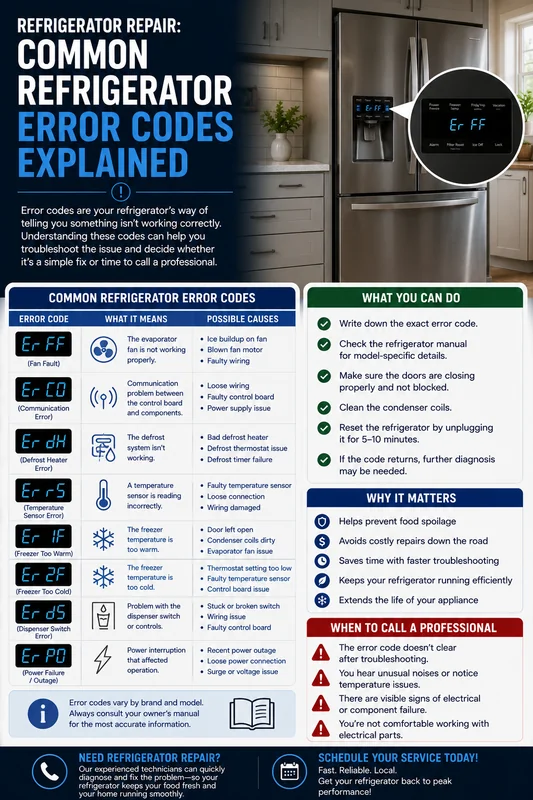
Modern refrigerators are smarter than ever. Many of today’s models use advanced electronic control boards, temperature sensors, and self-diagnostic systems to monitor their performance around the clock. When something isn’t working correctly, the refrigerator often displays an error code instead of simply stopping.
Seeing letters and numbers flashing on the display can be confusing. Many homeowners immediately assume the refrigerator has suffered a major failure and needs to be replaced. Fortunately, that’s rarely the case.
An error code doesn’t always identify a failed part. Instead, it tells technicians which system is experiencing a problem. Sometimes the solution is as simple as resetting the appliance, while other situations require professional refrigerator repair.
Understanding what these codes mean can help you respond quickly and avoid unnecessary damage to your food and appliance.
What Is a Refrigerator Error Code?
An error code is a message generated by the refrigerator’s control board.
Throughout every day, electronic sensors monitor temperatures, fan operation, defrost cycles, compressor performance, and communication between various components.
If the control board detects something outside its normal operating range, it stores an error and may display a code on the control panel.
These codes are designed to help technicians diagnose problems more efficiently, but they should never be used as the only basis for replacing parts.
Why Different Brands Use Different Codes
One of the biggest sources of confusion is that there isn’t a universal refrigerator error code system.
An error displayed on an LG refrigerator may mean something completely different on a Samsung, Whirlpool, GE, KitchenAid, Bosch, Frigidaire, or Sub-Zero refrigerator.
For that reason, professional technicians always consider:
- The refrigerator brand
- The model number
- The complete symptoms
- Diagnostic testing
Looking up a code online without verifying the model often leads homeowners to the wrong conclusion.
Temperature Sensor Errors
Temperature sensors are among the most common components monitored by modern refrigerators.
If a sensor begins sending incorrect information, the refrigerator may struggle to maintain proper temperatures.
Possible symptoms include:
- Food freezing unexpectedly
- Refrigerator running constantly
- Warm refrigerator compartment
- Temperature fluctuations
- Random cooling problems
Sometimes the sensor itself has failed. In other cases, damaged wiring or the electronic control board may be responsible.
Evaporator Fan Errors
The evaporator fan moves cold air throughout the refrigerator.
When the fan stops operating correctly, cold air can no longer circulate efficiently.
Common symptoms include:
- Freezer remaining cold
- Refrigerator compartment becoming warm
- Weak airflow
- Unusual buzzing sounds
- Frost buildup
Many refrigerators display a fan-related error code when the control board detects improper fan operation.
Defrost System Errors
Automatic defrost systems prevent frost from accumulating on the evaporator coils.
If one part of the defrost system fails, heavy ice buildup can eventually block airflow and reduce cooling performance.
Possible causes include:
- Defrost heater failure
- Defrost thermostat problems
- Defrost sensor issues
- Electronic control board malfunctions
Ignoring these warning signs often results in progressively worse cooling.
Ice Maker Error Codes
Today’s refrigerators frequently monitor the ice maker as a separate system.
Ice maker-related errors may involve:
- Water supply problems
- Frozen fill tubes
- Motor failures
- Sensor issues
- Harvest cycle interruptions
If the refrigerator is making little or no ice, the displayed error code helps narrow the area that requires inspection.
Compressor and Inverter Errors
Many modern refrigerators use inverter compressors to improve energy efficiency and reduce operating noise.
If communication between the inverter board and compressor is interrupted, an error code may appear.
Possible symptoms include:
- Refrigerator not cooling
- Compressor failing to start
- Clicking sounds
- Constant running
- Warm freezer temperatures
Because inverter systems operate differently from traditional compressors, proper testing is essential before replacing expensive components.
Communication Errors Between Electronic Boards
High-end refrigerators often contain multiple electronic control boards that communicate with one another.
If communication is interrupted, the refrigerator may display a communication error.
Possible causes include:
- Loose wiring connections
- Failed control boards
- Power fluctuations
- Moisture damage
- Electrical component failure
These problems typically require specialized diagnostic equipment.
Door Sensor Errors
Some refrigerators monitor whether the doors close completely.
If a door switch or sensor malfunctions, you may notice:
- Interior lights staying on
- Constant door alarms
- Poor cooling performance
- Frost around the door
- Higher energy consumption
Sometimes the issue is as simple as a damaged door gasket preventing the door from sealing properly.
Should You Reset the Refrigerator?
Many homeowners immediately unplug the refrigerator after seeing an error code.
A power reset may occasionally clear a temporary electronic glitch, particularly after a power outage.
However, if the error returns shortly after restarting the appliance, the underlying problem still exists.
Repeatedly resetting the refrigerator without diagnosing the actual cause usually delays necessary repairs.
Never Replace Parts Based Only on an Error Code
This is one of the most common mistakes homeowners make.
An error code identifies the system experiencing difficulty—not necessarily the component that has failed.
For example:
- A fan error may actually be caused by frost buildup.
- A temperature error could result from poor airflow.
- A compressor error might involve the inverter board.
- A defrost error may be triggered by a faulty sensor rather than the heater itself.
Professional technicians perform electrical testing before replacing parts, preventing unnecessary expenses.
How to Reduce Refrigerator Problems
While electronics cannot be completely prevented from failing, routine maintenance helps reduce stress on the cooling system.
Good maintenance habits include:
- Clean the condenser coils every six to twelve months.
- Keep air vents inside the refrigerator unobstructed.
- Check that the door seals tightly.
- Avoid overloading shelves.
- Replace damaged door gaskets promptly.
- Schedule service when cooling performance changes.
Preventive maintenance helps keep both mechanical and electronic systems operating reliably.
When Should You Call a Professional for Refrigerator Repair?
Some refrigerator errors require immediate attention to prevent food spoilage and additional component damage.
Professional refrigerator repair is recommended if:
- An error code remains after restarting the appliance.
- The refrigerator isn’t cooling properly.
- Food spoils faster than usual.
- The compressor runs continuously.
- Ice production suddenly stops.
- Frost builds up inside the freezer.
- The refrigerator displays multiple error codes.
- Unusual noises accompany the warning.
Accurate diagnosis ensures the real problem is repaired instead of simply clearing the displayed code.
Trust ACE Appliance Repair for Professional Refrigerator Repair
At ACE Appliance Repair, our technicians work with the latest diagnostic equipment to identify refrigerator problems quickly and accurately. We service all major refrigerator brands and understand that the same error code can have different causes depending on the appliance.
Instead of replacing parts based on guesswork, we perform complete system diagnostics to determine exactly what’s wrong and recommend the most effective repair.
If your refrigerator is displaying an error code or has stopped cooling properly, don’t ignore the warning. Call ACE Appliance Repair today at (858) 412-3000 to schedule professional refrigerator repair and get your appliance back to reliable performance before a small issue becomes a costly breakdown.