
Oven Repair: Signs Your Control Board May Be Failing
Modern ovens are far more advanced than they were just a decade ago. Instead of relying solely on mechanical thermostats and switches, today’s ovens use electronic control boards to manage nearly every function—from setting the temperature and controlling the bake and broil elements to operating convection fans, timers, and digital displays.
When the control board begins to fail, the symptoms can be confusing. One day the oven works perfectly, and the next it won’t heat, displays an error code, or shuts off in the middle of cooking.
Because many other components can produce similar symptoms, it’s important not to assume the control board is the problem without proper testing. Understanding the warning signs can help you recognize when it’s time to schedule professional oven repair.
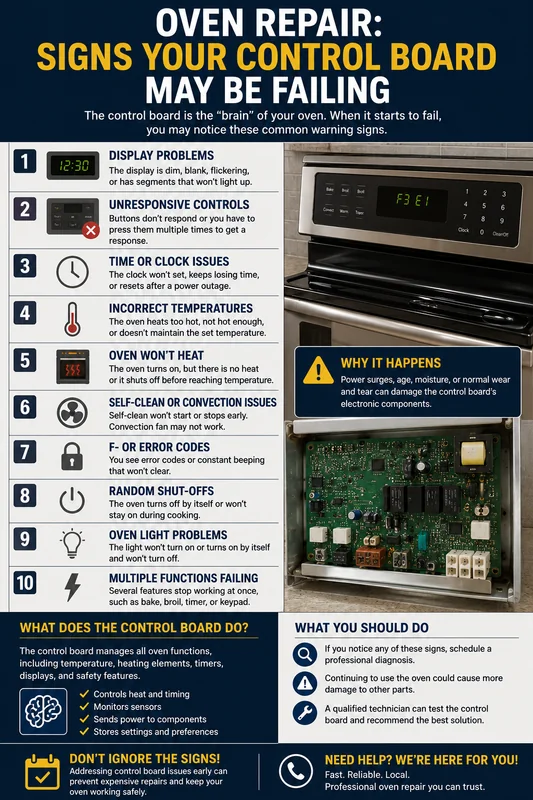
What Does the Oven Control Board Do?
The electronic control board acts as the brain of the oven.
When you select a cooking temperature, the control board receives information from temperature sensors and sends power to the appropriate heating elements, relays, fans, and other components.
It continuously monitors the cooking process to maintain the selected temperature and ensure the oven operates safely.
If the control board stops functioning correctly, multiple oven features may be affected at the same time.
The Oven Won’t Heat at All
One of the most common signs of a failing control board is an oven that won’t heat.
You may set the temperature, hear a relay click, and see the display operating normally, but the oven never gets warm.
Possible causes include:
- Failed electronic control board
- Faulty bake element
- Broken temperature sensor
- Damaged wiring
- Failed relay on the control board
Because several components work together, electrical testing is necessary before replacing any parts.
The Oven Heats Inconsistently
Perhaps your cookies burn on one side, casseroles take much longer than usual, or the oven never seems to reach the selected temperature.
Inconsistent heating can occur when the control board incorrectly cycles power to the heating elements.
You may notice:
- Wide temperature swings
- Longer preheating times
- Food cooking unevenly
- Inconsistent baking results
However, similar symptoms may also result from a faulty temperature sensor or heating element.
Random Error Codes Keep Appearing
Modern ovens include self-diagnostic systems that display error codes when something isn’t operating normally.
If the same error code repeatedly returns after clearing it, the control board may be receiving incorrect information—or failing to process that information correctly.
Some common causes include:
- Sensor communication problems
- Relay failures
- Internal circuit damage
- Software or memory faults
A technician can determine whether the control board is actually defective or simply responding to another failed component.
The Display Flickers or Stops Working
The electronic display is directly connected to the control board.
If you notice:
- Flickering numbers
- Blank displays
- Buttons that don’t respond
- Random beeping
- Display segments disappearing
the control board or its power supply may be malfunctioning.
Sometimes the issue involves loose electrical connections rather than the board itself.
The Oven Shuts Off During Cooking
Imagine preparing a holiday meal only to discover the oven turned itself off halfway through cooking.
Unexpected shutdowns may indicate:
- Overheating control board components
- Failing relays
- Electrical connection problems
- Internal board failures
Intermittent shutdowns should never be ignored because they usually become more frequent over time.
Bake or Broil Works, but Not Both
Your oven uses separate heating elements for baking and broiling.
If one function works perfectly while the other doesn’t, the control board may not be sending power to the correct element.
Possible symptoms include:
- Bake works, but broil doesn’t.
- Broil works, but bake doesn’t.
- One cooking mode heats much more slowly.
Although a failed heating element is often responsible, defective relays on the control board can produce identical symptoms.
Buttons or Touch Controls Stop Responding
Touchpads and electronic controls experience wear after years of daily use.
You may notice:
- Buttons requiring multiple presses
- Controls responding slowly
- Certain functions no longer working
- Random selections appearing on the display
In some ovens, the touchpad and control board are separate components. In others, they’re combined into one assembly.
Professional diagnosis helps determine which part requires replacement.
Power Surges Can Damage Control Boards
Electronic components are sensitive to electrical fluctuations.
Power outages, lightning strikes, or sudden voltage spikes can damage delicate circuits inside the control board.
After a power surge, homeowners sometimes notice:
- Blank displays
- Error codes
- Non-responsive controls
- Heating problems
Surge protection can help reduce the risk of future electronic damage.
Is It Always the Control Board?
Not at all.
Many oven problems that appear to involve the control board are actually caused by other components.
For example:
- A failed temperature sensor can confuse the control board.
- A damaged bake element prevents heating.
- Loose wiring interrupts electrical power.
- Faulty door switches affect certain cooking functions.
- A defective thermal fuse can disable the oven.
Replacing the control board without confirming the actual cause can become an expensive mistake.
Can a Control Board Be Repaired?
In some situations, electronic control boards can be repaired by specialized electronics companies.
However, whether repair or replacement makes the most sense depends on:
- The oven’s age
- The availability of replacement parts
- The extent of the board’s damage
- The overall condition of the appliance
A professional technician can explain the most practical and cost-effective option.
How to Help Protect Your Oven’s Electronics
While no electronic component lasts forever, a few simple habits can reduce unnecessary stress on your oven.
Helpful tips include:
- Avoid slamming the oven door.
- Keep the control panel clean and dry.
- Use surge protection whenever possible.
- Don’t ignore recurring error codes.
- Schedule service when heating performance changes.
Addressing small electrical issues early often prevents larger failures later.
When Should You Call a Professional for Oven Repair?
If your oven begins showing electrical or heating problems, professional diagnosis is the safest approach.
Schedule oven repair if you notice:
- The oven won’t heat.
- Error codes repeatedly appear.
- The display flickers or goes blank.
- Bake or broil stops working.
- The oven shuts off during cooking.
- Touch controls become unresponsive.
- Temperatures become inconsistent.
Proper testing ensures the real problem is identified before expensive components are replaced unnecessarily.
Trust ACE Appliance Repair for Professional Oven Repair
At ACE Appliance Repair, we repair ovens from all major appliance brands and understand how today’s electronic control systems work. Our experienced technicians use professional diagnostic equipment to determine whether the issue involves the control board, heating elements, temperature sensors, wiring, or another component.
We believe in accurate diagnostics, honest recommendations, and quality repairs that restore your oven’s performance without unnecessary expenses.
If your oven is displaying error codes, heating inconsistently, or showing signs of electronic control problems, call ACE Appliance Repair today at (858) 412-3000. We’ll diagnose the issue, explain your options, and help you get back to cooking with confidence.