
Range Repair: Why Your Gas Burners Keep Clicking
You turn the knob on your gas range, hear the familiar clicking sound, and the burner lights as expected. Normally, the clicking stops immediately after ignition. But what if it doesn’t? What if the burner continues clicking while it’s lit, or every burner on the cooktop starts clicking at the same time?
This is one of the most common reasons homeowners schedule range repair. While a constantly clicking burner may seem like a minor annoyance, it often indicates that one of the ignition system components isn’t working correctly.
The good news is that many ignition problems can be repaired without replacing the entire appliance.
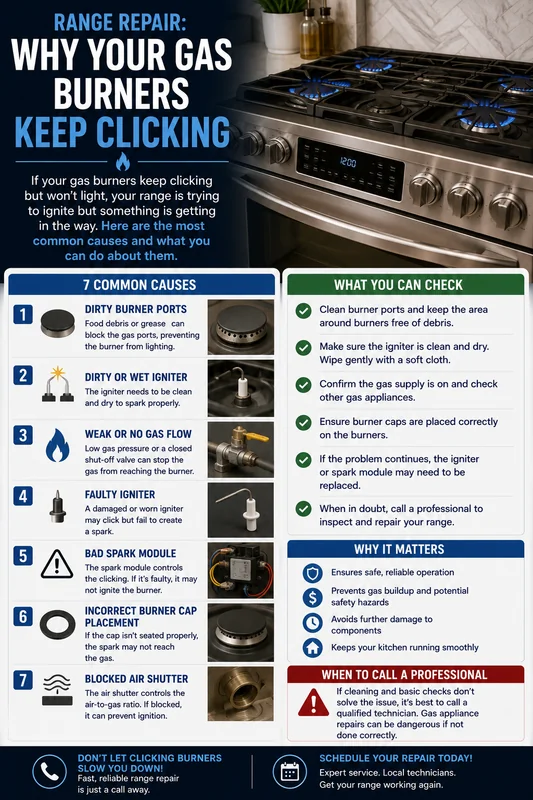
Why Do Gas Burners Click?
The clicking sound comes from the electronic ignition system.
When you turn a burner knob, the spark module sends high-voltage electricity to the igniter electrode. The electrode creates a spark that ignites the gas flowing from the burner.
Once the flame is established, the clicking should stop almost immediately.
If it continues, the ignition system is still trying to create a spark because it believes the burner hasn’t ignited properly.
Moisture Is One of the Most Common Causes
One of the simplest reasons a burner continues clicking is moisture.
Water can enter the burner assembly after:
- Cleaning the cooktop
- Boiling water over the burner
- Steam from cooking
- Heavy spills
Even a small amount of moisture around the ignition electrode can interfere with the spark.
Fortunately, allowing the burner to dry completely often resolves the problem.
Food Debris Can Block the Ignition System
Grease, food particles, and cooking residue gradually accumulate around the burner cap and ignition electrode.
If the burner ports become partially blocked, gas may not flow evenly around the burner.
This can delay ignition and cause continuous clicking.
Common signs include:
- Delayed ignition
- Uneven flames
- Clicking after the burner lights
- Burners taking several attempts to ignite
Keeping the burner assembly clean helps maintain reliable ignition.
The Burner Cap May Be Misaligned
Many homeowners remove burner caps during cleaning.
If the cap isn’t positioned correctly afterward, the gas flame may not reach the ignition electrode as intended.
Symptoms include:
- Clicking without ignition
- Uneven flames
- Flame only on one side of the burner
- Multiple attempts needed to light the burner
Always make sure the burner cap sits flat in its proper position.
A Dirty or Damaged Igniter Electrode
The igniter electrode creates the spark that lights the gas.
Over time, it can become:
- Dirty
- Grease-covered
- Cracked
- Chipped
- Worn from repeated use
A damaged electrode may continue sparking even after the burner is lit.
If the ceramic insulation is cracked, replacement is usually necessary.
A Faulty Spark Module
The spark module supplies electricity to every burner igniter.
If it begins malfunctioning, you may notice:
- Multiple burners clicking together
- Continuous clicking after ignition
- Random clicking without touching the controls
- Weak or inconsistent sparks
Because several burners often share the same spark module, problems affecting multiple burners frequently point to this component.
Burner Switches Can Stick
Each burner control knob activates a small ignition switch.
After years of use, grease, moisture, or wear may prevent the switch from returning to its normal position.
Possible symptoms include:
- Clicking continues after releasing the knob
- Clicking starts unexpectedly
- One burner repeatedly clicking
- Several burners clicking simultaneously
Replacing the faulty switch often restores normal operation.
Loose Wiring Can Interrupt the Ignition System
Gas ranges contain high-voltage wiring that connects the spark module to each ignition electrode.
Loose or damaged wiring may cause:
- Intermittent clicking
- Weak spark
- Failure to ignite
- Continuous ignition attempts
Electrical testing is usually required to locate wiring problems safely.
Why Do All the Burners Click Together?
Many homeowners become concerned when every burner begins clicking, even though only one burner is being used.
In many gas ranges, this is completely normal during startup.
The spark module sends power to every igniter simultaneously, but only the burner receiving gas will ignite.
However, if all burners continue clicking after ignition, one of the ignition system components likely requires attention.
Should You Keep Using the Range?
If the burner lights normally and the clicking stops after a few seconds, there’s usually no cause for concern.
However, if clicking continues continuously, returns unexpectedly, or is accompanied by delayed ignition or a gas smell, the range should be inspected.
Never ignore:
- The smell of gas
- Burners that won’t ignite
- Repeated delayed ignition
- Visible sparks in unusual locations
- Burners producing uneven flames
These symptoms may indicate a developing safety issue.
Simple Maintenance Can Prevent Ignition Problems
Routine cleaning helps keep your gas range operating reliably.
Helpful maintenance includes:
- Clean burner caps regularly.
- Remove food debris from burner ports.
- Dry the cooktop thoroughly after cleaning.
- Avoid flooding burners with excessive water.
- Make sure burner caps are properly seated.
- Wipe grease away from ignition electrodes.
Regular cleaning reduces many of the problems that lead to continuous clicking.
When Should You Call a Professional for Range Repair?
If your gas burners continue clicking after they’ve ignited, professional diagnosis is recommended.
Schedule range repair if you notice:
- Continuous clicking
- Delayed burner ignition
- Multiple burners clicking constantly
- Burners that won’t light
- Uneven flames
- Sparks occurring in the wrong location
- Gas odors
- Cracked ignition electrodes
Prompt repairs help restore reliable performance while ensuring your range operates safely.
Trust ACE Appliance Repair for Professional Range Repair
At ACE Appliance Repair, we repair gas ranges from all major appliance brands. Our experienced technicians diagnose ignition problems involving spark modules, igniter electrodes, burner switches, wiring, gas valves, and burner assemblies with precision and care.
We believe in accurate diagnostics, honest recommendations, and dependable repairs that restore your appliance without unnecessary part replacements.
If your gas burners keep clicking or aren’t igniting properly, don’t ignore the warning signs. Call ACE Appliance Repair today at (858) 412-3000 to schedule professional range repair and get your kitchen back to safe, reliable cooking.