
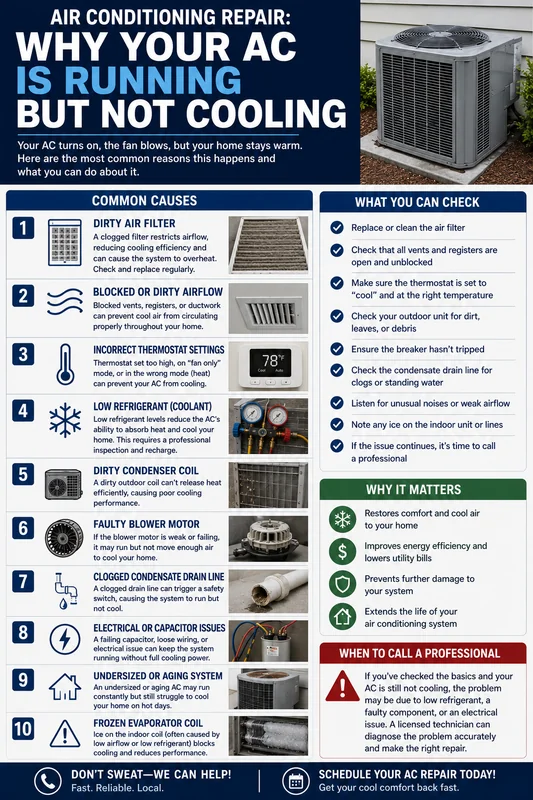
Air Conditioning Repair: Why Your AC Is Running but Not Cooling
There’s nothing more frustrating than hearing your air conditioner running on a hot summer day, only to realize that warm air is coming from the vents. The thermostat is set correctly, the system appears to be operating, but the temperature inside your home continues to rise.
Many homeowners immediately assume they need a new air conditioner. Fortunately, that’s usually not the case.
An AC that runs but doesn’t cool is one of the most common reasons homeowners schedule air conditioning repair. In many situations, the problem is caused by a failed component, restricted airflow, or a maintenance issue that can be repaired without replacing the entire system.
Understanding the most common causes can help you recognize the warning signs early and prevent more expensive repairs.
How Does an Air Conditioner Cool Your Home?
An air conditioning system removes heat from inside your home rather than creating cold air.
The indoor evaporator coil absorbs heat from the air, while the outdoor condenser releases that heat outside. Refrigerant continuously circulates between these two units, allowing the system to cool your home efficiently.
For the process to work properly, every major component must operate correctly, including:
- The thermostat
- Indoor blower motor
- Outdoor condenser fan
- Compressor
- Refrigerant system
- Air filter
- Electrical components
If any one of these systems fails, your AC may continue running while delivering little or no cooling.
Check the Thermostat First
Before assuming there’s a major mechanical problem, verify that the thermostat is set correctly.
It may sound obvious, but technicians often discover issues caused by:
- The thermostat accidentally being switched to Fan instead of Cool
- Incorrect temperature settings
- Low thermostat batteries
- Programming errors on smart thermostats
If everything appears correct and the system still isn’t cooling, it’s time to investigate further.
A Dirty Air Filter Restricts Airflow
One of the simplest and most overlooked causes of poor cooling is a clogged air filter.
When airflow becomes restricted, the evaporator coil can’t absorb heat efficiently.
Common symptoms include:
- Weak airflow from the vents
- Longer cooling cycles
- Higher energy bills
- Rooms that never reach the desired temperature
Replacing the air filter regularly is one of the easiest ways to improve cooling performance and protect your HVAC system.
A Failed Capacitor May Prevent the Outdoor Unit from Working Properly
A failed capacitor is one of the most common AC repairs homeowners face.
The capacitor provides the electrical boost needed to start the compressor and condenser fan motor.
When it begins to fail, you may notice:
- The outdoor unit humming
- The fan not spinning
- Warm air from the vents
- The system struggling to start
- Cooling that suddenly stops
Fortunately, capacitor replacement is often far less expensive than many homeowners expect.
Low Refrigerant Can Reduce Cooling
Your air conditioner doesn’t consume refrigerant during normal operation.
If refrigerant levels are low, there’s almost always a leak somewhere in the sealed system.
Possible symptoms include:
- Warm air from the vents
- Ice forming on refrigerant lines
- Longer cooling cycles
- Higher humidity indoors
- The system running continuously
Simply adding refrigerant without repairing the leak is only a temporary solution.
Frozen Evaporator Coils Block Cooling
If airflow becomes restricted or refrigerant levels drop, the evaporator coil may freeze.
As ice builds up, less air can pass through the coil, reducing cooling even further.
Signs of a frozen evaporator include:
- Weak airflow
- Ice on refrigerant lines
- Water around the indoor unit
- Warm air from the vents
Although turning the system off may temporarily melt the ice, the underlying problem still needs to be repaired.
The Outdoor Condenser Needs Room to Breathe
Your outdoor unit releases heat collected from inside your home.
If airflow around the condenser becomes restricted, cooling efficiency drops.
Common causes include:
- Dirt-covered condenser coils
- Leaves and debris
- Overgrown bushes
- Grass clippings
- Poor clearance around the unit
Keeping at least two feet of open space around the condenser helps maintain proper airflow.
A Compressor Problem Can Stop Cooling
The compressor is the heart of your air conditioning system.
If it isn’t operating correctly, refrigerant cannot circulate through the system.
Warning signs include:
- Warm air from every vent
- The outdoor unit running loudly
- Clicking noises
- Constant operation without cooling
- Breaker trips
Because compressors are expensive components, accurate diagnosis is essential before any repair decisions are made.
Electrical Components Can Fail Without Warning
Modern HVAC systems rely on numerous electrical controls.
Problems involving contactors, relays, wiring, or control boards can interrupt cooling while allowing parts of the system to continue operating.
Possible symptoms include:
- Outdoor unit not starting
- Indoor blower running alone
- Random shutdowns
- Error codes
- Intermittent cooling
Electrical diagnostics help identify these problems quickly and accurately.
Dirty Condenser Coils Reduce Efficiency
Over time, the outdoor condenser coil collects dust, pollen, pet hair, and other debris.
As the coil becomes dirty, heat transfer becomes less efficient.
You may notice:
- Longer cooling times
- Higher electric bills
- Constant system operation
- Reduced cooling on hot days
Routine maintenance keeps the condenser operating at peak efficiency.
Why You Shouldn’t Ignore Poor Cooling
Even if your AC is still running, poor cooling usually means one or more components are under additional stress.
Ignoring the problem can lead to:
- Compressor damage
- Frozen evaporator coils
- Higher energy costs
- Electrical failures
- Complete system breakdown
Scheduling repairs early often prevents much more expensive repairs later.
Simple Maintenance Can Help Prevent Cooling Problems
Many common AC issues can be avoided with routine maintenance.
Here are a few simple habits to follow:
- Replace air filters regularly.
- Keep the outdoor condenser clean.
- Trim vegetation around the outdoor unit.
- Keep supply and return vents unobstructed.
- Schedule professional maintenance once a year.
- Pay attention to unusual noises or longer cooling cycles.
Preventive maintenance keeps your system operating efficiently while extending its lifespan.
When Should You Call a Professional for Air Conditioning Repair?
If your air conditioner continues running but your home isn’t getting cooler, it’s time for a professional inspection.
Schedule air conditioning repair if you notice:
- Warm air coming from the vents
- Weak airflow
- Ice on refrigerant lines
- The outdoor fan not spinning
- The system running constantly
- Unusual noises
- Higher utility bills
- Cooling performance getting worse
Prompt diagnosis can often prevent a small issue from becoming a major repair.
Trust ACE Appliance Repair for Professional Air Conditioning Repair
At ACE Appliance Repair, we understand how important dependable air conditioning is during Southern California’s warmest months. Our experienced technicians diagnose cooling problems on residential AC systems quickly and accurately, identifying issues involving capacitors, compressors, refrigerant leaks, electrical components, airflow restrictions, and more.
We believe in honest recommendations, accurate diagnostics, and quality workmanship that restores your comfort without unnecessary repairs.
If your air conditioner is running but not cooling your home, don’t wait until it stops working completely. Call ACE Appliance Repair today at (858) 412-3000 to schedule professional air conditioning repair and enjoy a cool, comfortable home again.