
AC Repair: Why a Failed Capacitor Is One of the Most Common AC Problems
It’s the middle of summer, the thermostat is set to 72°F, and suddenly your air conditioner stops cooling. You can hear the outdoor unit humming, but the fan isn’t spinning, or the system tries to start over and over without success. For many homeowners, this feels like a major breakdown that could cost thousands of dollars.
Fortunately, that’s not always the case.
One of the most common air conditioning repairs is also one of the least expensive: replacing a failed capacitor. Although it’s a relatively small electrical component, the capacitor plays a critical role in helping your AC system start and run properly. When it fails, your air conditioner may struggle to operate or stop working altogether.
Understanding how a capacitor works and recognizing the early warning signs can help you avoid bigger problems and restore your home’s comfort more quickly.
What Does an AC Capacitor Do?
Think of a capacitor as a temporary energy storage device.
When your air conditioner starts, several components require a burst of electrical power. The capacitor stores electricity and delivers that extra energy needed to start the compressor and the fan motors. Some capacitors also continue supplying a steady electrical boost while the system is running.
Without a properly functioning capacitor, the compressor or fan motor may not have enough power to start or operate efficiently.
Most residential air conditioners use either:
- A start capacitor, which provides extra power during startup.
- A run capacitor, which helps keep the motor operating efficiently.
- A dual run capacitor, which powers both the compressor and the outdoor fan motor. This is the most common design found in modern home air conditioning systems.
Why Do Capacitors Fail So Often?
Capacitors naturally wear out over time.
Unlike many mechanical parts, they slowly lose their ability to store electrical energy. Every time your air conditioner starts, the capacitor experiences a small amount of wear.
Several factors can shorten its lifespan:
- High outdoor temperatures
- Frequent cooling cycles
- Voltage fluctuations
- Aging electrical components
- Poor airflow around the outdoor unit
- Normal wear after years of operation
In warmer climates like Southern California, where air conditioners run for long periods during the summer, capacitor failures are especially common.
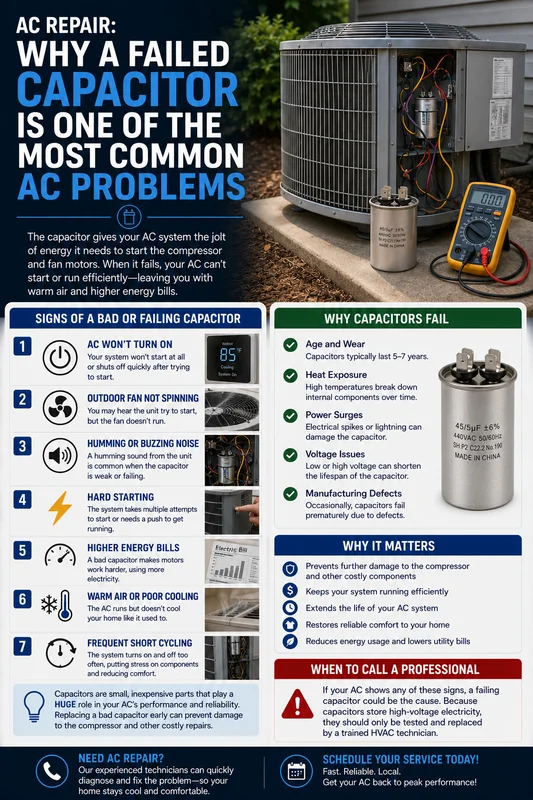
Signs Your AC Capacitor May Be Failing
A failing capacitor often gives warning signs before it stops working completely.
Homeowners commonly notice:
- The air conditioner struggles to start.
- The outdoor unit hums but doesn’t turn on.
- The fan starts slowly.
- The system shuts off unexpectedly.
- Cooling performance becomes inconsistent.
- Warm air blows from the vents.
- The air conditioner starts after several attempts.
Because these symptoms can also indicate other electrical problems, professional testing is the safest way to identify the exact cause.
Your AC Hums but Doesn’t Start
This is one of the classic signs of a failed capacitor.
You may hear the outdoor condenser unit making a humming sound, but the fan isn’t spinning and the compressor never fully starts.
The motor is attempting to operate but isn’t receiving enough electrical assistance from the capacitor.
Continuing to leave the system running in this condition can overheat the compressor or fan motor, turning a relatively simple repair into a much more expensive one.
The Outdoor Fan Isn’t Spinning
If the indoor blower is running but the outdoor fan remains still, the capacitor could be preventing the fan motor from starting.
Some homeowners are tempted to push the fan blades with a stick after shutting off the power, hoping to get the system running again.
While the fan may briefly start if the capacitor is weak, this is not a repair and should never be considered a safe or permanent solution.
The underlying electrical problem still needs to be corrected.
Your Home Takes Much Longer to Cool
A weak capacitor may still allow the system to operate, but not efficiently.
As the capacitor loses strength, the compressor and fan motors work harder during every cooling cycle.
You may notice:
- Longer cooling times
- Higher electric bills
- More frequent cycling
- Uneven temperatures throughout the home
Replacing a weak capacitor often restores normal performance before other components become damaged.
Can a Bad Capacitor Damage Other Parts?
Yes.
Although the capacitor itself is relatively inexpensive, ignoring the problem can create much larger repair bills.
A failing capacitor places extra stress on:
- The compressor
- The condenser fan motor
- Electrical contactors
- Other starting components
The compressor is particularly vulnerable because it depends on the capacitor every time the system starts.
Replacing a capacitor promptly can sometimes prevent one of the most expensive repairs in an entire air conditioning system.
What Causes Capacitors to Wear Out Faster?
While every capacitor eventually reaches the end of its service life, certain conditions accelerate the process.
Common causes include:
- Extreme summer temperatures
- Dirty condenser coils
- Poor ventilation around the outdoor unit
- Power surges
- Frequent thermostat cycling
- Aging HVAC equipment
Routine maintenance helps reduce unnecessary strain on the entire system.
Is Capacitor Replacement Expensive?
Compared to many HVAC repairs, capacitor replacement is generally one of the more affordable services.
However, it’s important to remember that not every air conditioner that won’t start has a failed capacitor.
Symptoms can also be caused by:
- A faulty contactor
- Thermostat problems
- Electrical wiring issues
- Fan motor failure
- Compressor problems
- Control board malfunctions
Replacing parts without proper testing can waste both time and money.
Can You Replace an AC Capacitor Yourself?
Many online videos make capacitor replacement appear simple.
In reality, capacitors can store a dangerous electrical charge even after power has been disconnected.
Improper handling may result in serious injury or damage to the air conditioning system.
Professional technicians use specialized equipment to safely discharge, test, and replace capacitors while confirming that no additional electrical problems are present.
How to Help Your Air Conditioner Last Longer
Although no capacitor lasts forever, regular maintenance can extend the life of your entire cooling system.
A few simple steps include:
- Schedule annual AC maintenance.
- Keep the outdoor condenser clean.
- Trim vegetation around the outdoor unit.
- Replace air filters regularly.
- Don’t ignore unusual noises or delayed startup.
- Have electrical components inspected before the peak cooling season.
Preventive maintenance helps identify weak capacitors before they leave your home without air conditioning on the hottest day of the year.
When Should You Call a Professional for AC Repair?
If your air conditioner won’t start or isn’t cooling properly, it’s best to have the system inspected as soon as possible.
Professional AC repair is recommended if you notice:
- The outdoor unit hums but doesn’t start.
- The fan isn’t spinning.
- Warm air is coming from the vents.
- The system repeatedly trips the breaker.
- Cooling performance suddenly declines.
- The air conditioner struggles to start.
- The unit cycles on and off frequently.
Early diagnosis can prevent damage to more expensive components and restore reliable cooling much sooner.
Trust ACE Appliance Repair for Reliable AC Repair
At ACE Appliance Repair, we know that a failed capacitor is one of the most common reasons an air conditioner stops working—but it’s far from the only possibility. Our experienced technicians perform complete system diagnostics to determine the exact cause of the problem before recommending any repairs.
Whether your system needs a new capacitor, fan motor, electrical component, or a more advanced repair, we’re committed to providing honest service, quality workmanship, and clear communication every step of the way.
If your air conditioner isn’t starting or has stopped cooling your home, don’t wait for the problem to get worse. Call ACE Appliance Repair today at (858) 412-3000 to schedule professional AC repair and get your comfort back as quickly as possible.